- Effective Sales Pitch vs. Sales Presentation: Understanding the Difference
- Planning Your Sales Pitch Strategy Beyond Templates
- What Makes a High-Conversion Perfect Sales Pitch in 2026?
- How to Create a Strong Sales Pitch Presentation Quickly
- Sales Presentation Design Best Practices for 2026
- How Many Slides Should a Sales Deck Include?
- Conclusion
- FAQs
Create a High-Conversion Sales Pitch Presentation in 2026


- Effective Sales Pitch vs. Sales Presentation: Understanding the Difference
- Planning Your Sales Pitch Strategy Beyond Templates
- What Makes a High-Conversion Perfect Sales Pitch in 2026?
- How to Create a Strong Sales Pitch Presentation Quickly
- Sales Presentation Design Best Practices for 2026
- How Many Slides Should a Sales Deck Include?
- Conclusion
- FAQs


The era of the traditional sales pitch deck is over.
In 2026, buyers no longer tolerate slide-heavy presentations filled with company history, feature lists, and generic value statements. They arrive informed, skeptical, and short on time. What they want is relevance, clarity, and proof that you understand their specific business reality.
High-conversion sales pitch presentations today are not about controlling the screen. They are about guiding a strategic conversation. The most effective sellers no longer “present” in the classic sense, they facilitate, listen, and adapt in real time.
This guide breaks down how to create a modern sales pitch presentation in 2026 that builds trust, earns attention, and moves deals forward. You’ll learn how to structure your pitch, align it with buyer psychology, and design presentations that feel less like a monologue and more like a partnership.
Effective Sales Pitch vs. Sales Presentation: Understanding the Difference
Although often used interchangeably, a sales pitch and a sales presentation serve very different purposes and confusing the two is a common reason deals stall.
What Is a Sales Pitch?
A sales pitch is the high-level narrative.
Its job is to:
- Sell the vision
- Frame the opportunity
- Create enough value to earn the next conversation
A strong sales pitch is concise, focused, and outcome-driven. It answers the buyer’s most important question: Why should I care?
What Is a Sales Presentation?
A sales presentation is the deep dive.
It includes:
- Detailed workflows
- Technical explanations
- Timelines, pricing logic, and implementation details
The critical insight for 2026:
You should never start with the full presentation.
The most effective approach is to lead with a compelling sales pitch, secure alignment on the “why,” and only then move into the “how” once the buyer signals readiness.
Planning Your Sales Pitch Strategy Beyond Templates

High-conversion sales presentations are not built in PowerPoint. They are built during research.
In 2026, one-size-fits-all presentation templates are a liability. Buyers can instantly recognize generic decks, and generic decks signal low effort, low relevance, and low value.
A winning sales team operates on radical relevance, every pitch feels tailored, intentional, and specific to the buyer’s situation.
What Makes a High-Conversion Perfect Sales Pitch in 2026?
Context is the defining factor.
Compare these two statements:
- “Our software saves time.”
- “Our software automates your manual inventory reconciliation process, which currently costs your operations team 14 hours every week.”
The second statement converts because it reflects the buyer’s reality. High-conversion pitches make prospects feel understood before they ever feel sold to.
The Three-Point Research Method
Before opening your slide editor, your pitch should satisfy three research pillars:
1. The Macro Trend
Identify the industry-level shift creating pressure:
- Regulatory changes
- Market consolidation
- AI-driven disruption
- New buyer expectations
2. The Micro Friction
Pinpoint the specific pain point affecting their team:
- Bottlenecks
- Inefficiencies
- Missed revenue opportunities
Sources can include earnings calls, LinkedIn activity, discovery conversations, or public reports.
3. The Personal Win
Every deal has a human motivator.
- Career advancement
- Reduced workload
- Risk avoidance
Your pitch should speak not only to the business outcome, but to the individual across the table.
How to Create a Strong Sales Pitch Presentation Quickly
While deep research is ideal, modern B2B sales often require speed. High-performing teams know how to prepare efficiently without sacrificing relevance.
Here’s how to build a credible, buyer-focused pitch fast:
- Audit the “About” and “News” pages
Reference one recent win or strategic initiative to establish relevance early. - Run a 30-second LinkedIn scan
Review the buyer’s featured posts and recent activity to understand what they care about. - Define the “Why Now”
Ask: If nothing changes, what happens to them in six months?
This insight becomes the urgency driver for your pitch.
The 7-Slide Winning Framework for Sales Presentations
Brevity is a competitive advantage. A 40-slide deck does not signal thoroughness, it signals inefficiency. High-conversion presentations in 2026 follow a lean, psychologically sequenced structure designed to maintain momentum.
Slide 1: The Hook
Capture attention immediately by reflecting the buyer’s world back to them.
Use:
- A provocative question
- A market insight
- A sharp statistic tied to their goals
Goal: Confirm they are in the right conversation.
Slide 2: The Shared Reality
Define the current state and the emerging gap.
Demonstrate that you understand:
- Where they are today
- Where the market is moving
- Why staying the same is becoming risky
Goal: Establish strategic empathy.
Slide 3: The Cost of Inaction
Your biggest competitor is often “no decision.”
This slide quantifies what happens if nothing changes:
- Lost revenue
- Wasted time
- Competitive disadvantage
Goal: Create professional urgency without fear-mongering.
Slide 4: The Transformation
Only now should your solution appear.
Avoid feature lists. Instead, show:
- Before vs. after scenarios
- Outcome-driven transformation
- How the buyer’s reality improves
Goal: Position your solution as the logical bridge.
Slide 5: Proof Points
Replace long testimonials with focused evidence:
- One compelling metric
- One relevant case
- One short success story
Goal: Reduce perceived risk and build confidence.
Slide 6: The Roadmap
Ambiguity kills deals.
Show a simple, visual 30–60–90 day plan that answers:
- What happens after “yes”?
- How much effort is required?
- Who is involved?
Goal: Make progress feel inevitable.
Slide 7: The Collaborative CTA
End with options, not pressure.
Offer a menu of next steps:
- Technical deep dive
- Stakeholder workshop
- Pilot program
Goal: Maintain momentum while giving the buyer control.
Sales Presentation Design Best Practices for 2026
Visual design is no longer decoration; it’s a conversion tool.
Your slides should resemble a clean SaaS dashboard, not a dense corporate document. In hybrid and remote selling environments, clarity must be instant.
The Updated 10/20/30 Rule
Modern attention demands adaptation:
- 10 Key Visuals
Limit your core presentation to high-impact visuals. Move details to an appendix. - 20 Seconds per Concept
Change visuals frequently to sustain engagement. - 30% White Space
Guide attention and reduce cognitive load.
One Slide, One Insight
Each slide should deliver a single “aha” moment. When slides try to do too much, conversations stall. Momentum comes from simplicity.
How Many Slides Should a Sales Deck Include?
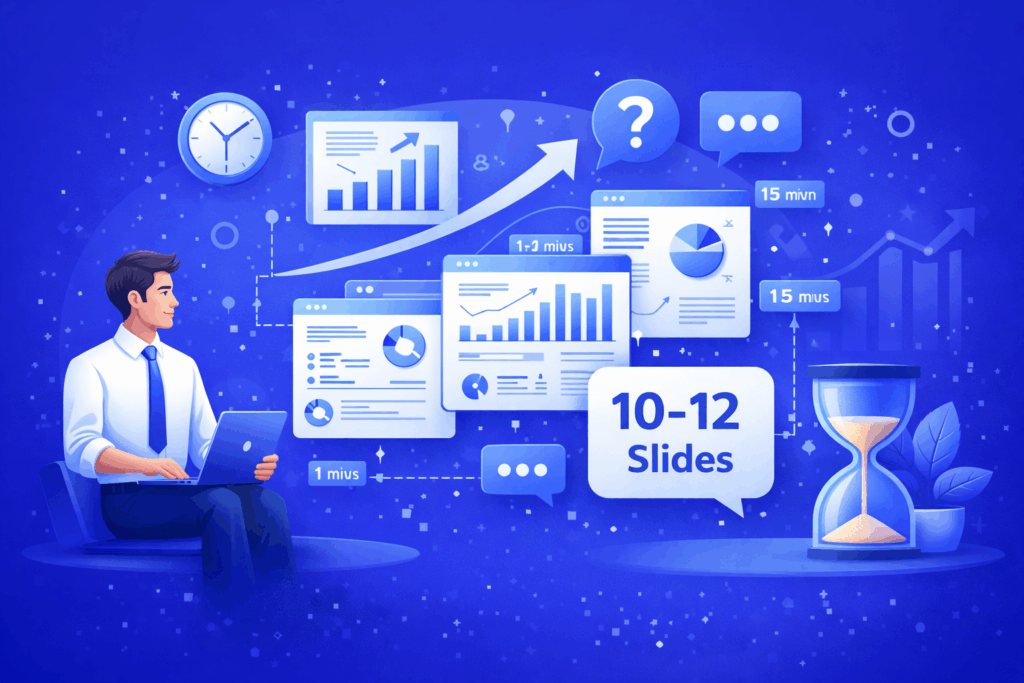
While the 7-slide framework is ideal, total slide count depends on meeting length.
For a 30-minute sales conversation:
- 10–12 slides total
- 15 minutes presenting
- 15 minutes discussion
Remember: the goal is not to finish the deck, it’s to start the right conversation.
Designing for the Secondary Audience
Sales decks are often forwarded internally.
To ensure clarity:
- Add brief context notes where needed
- Ensure mobile readability
- Avoid relying solely on verbal explanations
Overcoming Objections Without Losing Momentum
Objections are not rejection; they are requests for clarity.
High-performing sellers anticipate concerns and prepare for them without cluttering the main narrative.
The Appendix Strategy
Move:
- Technical specs
- ROI models
- Security details
into a structured appendix.
When objections arise, you can navigate directly to a prepared slide, demonstrating confidence and preparation while keeping the core pitch clean.
Conclusion
High-conversion sales pitch presentations in 2026 are built on clarity, relevance, and collaboration.
The most successful sellers no longer rely on flashy animations or exhaustive slide decks. They focus on understanding the buyer’s world, guiding a strategic conversation, and making the path forward feel obvious.
When your presentation becomes a roadmap rather than a pitch, you stop being perceived as a vendor, and start being seen as a partner.
FAQs
What is the ideal length for a sales pitch presentation?
Should a sales pitch focus on features or outcomes?
How do you make a sales pitch buyer-centric?
Are templates effective for sales presentations?
Related Articles
 January 23rd, 2026
What Is the Main Purpose of Developing a Business Pitch? The Complete 2026 Guide for Entrepreneurs
Business Presentation Tips- March 25th, 2026
Post Mortem Meeting Agenda: A Complete Guide for Teams
Business Presentation Tips - January 27th, 2026
How Do You Pitch a Business in 60 Seconds? The Complete Framework for Founders
Business Presentation Tips