- 1. What is a weekly report?
- 2. Why weekly reports matter for your career
- 3. What to include in a weekly report
- 4. The weekly report template you can use right now
- 5. How to write a weekly report that gets noticed
- 6. The biggest mistake: reporting activity instead of impact
- 7. Different types of weekly reports
- 8. When your weekly report needs to be a presentation
- 9. Using templates and tools to save time
- 10. Quick-reference FAQ

- 1. What is a weekly report?
- 2. Why weekly reports matter for your career
- 3. What to include in a weekly report
- 4. The weekly report template you can use right now
- 5. How to write a weekly report that gets noticed
- 6. The biggest mistake: reporting activity instead of impact
- 7. Different types of weekly reports
- 8. When your weekly report needs to be a presentation
- 9. Using templates and tools to save time
- 10. Quick-reference FAQ


Every Monday morning, someone somewhere is staring at an empty document, trying to remember what they actually did last week. If that person is you, this guide will change how you approach weekly reporting forever.
1. What is a weekly report?
A weekly report is a structured summary of what was accomplished, what is in progress, and what is planned for the coming week. It is one of the most common communication formats in the corporate world, used by individuals, teams, and entire departments to maintain visibility and alignment.
Weekly reports go by many names depending on your organization: weekly status updates, weekly standups, Friday updates, weekly team reports, or simply “the weekly.” Regardless of what it is called, the purpose is the same: to create a shared understanding of progress without requiring a meeting.
At its simplest, a weekly report answers three questions:
- What did I accomplish this week?
- What am I working on next week?
- Is there anything blocking my progress or requiring a decision?
| Note: A weekly report is not a to-do list or a diary. It is a professional communication document. The audience is your manager, your team, or your stakeholders, and it should be written with that audience in mind. |
2. Why weekly reports matter for your career
If you are early in your career, you may wonder why weekly reports deserve any attention at all. They can feel like paperwork that takes time away from actual work. But professionals who treat their weekly reports as a genuine communication tool tend to advance faster. Here is why.
Your work becomes visible
In a busy organization, good work that is not communicated is often invisible. Your manager may be overseeing five to ten people at once. A well-written weekly report ensures your contributions are on record, even when your manager cannot directly observe your day-to-day work.
You establish a pattern of reliability
Submitting a well-structured weekly report consistently, on time, every week, signals that you are organized, accountable, and reliable. These are qualities that get noticed long before your next performance review.
You create a record of your own growth
Over time, your weekly reports become a log of your professional development. When annual review season arrives, you will not be scrambling to remember what you achieved. Your weekly reports tell the whole story.
You surface problems early
Blockers and risks that appear in a weekly report get addressed faster than problems that stay inside your head. Reporting an issue is not a sign of weakness. It is how professional teams stay aligned and solve problems before they escalate.
You build your personal brand
The quality of your written communication reflects directly on how you are perceived professionally. A crisp, clear weekly report signals intelligence, organization, and care for your audience. A vague or messy one does the opposite.
3. What to include in a weekly report
The best weekly reports are concise and consistent. They contain enough information to be useful but not so much that they become a burden to read. Here are the core sections every weekly report should have.
- Accomplishments this week: The key things you completed or progressed significantly. Focus on outcomes, not activities.
- Work in progress: Tasks and projects that are underway but not yet complete, with a brief note on where each one stands.
- Plan for next week: What you intend to focus on in the coming week. Helps managers spot misaligned priorities before it is too late.
- Blockers and dependencies: Anything preventing you from moving forward, or anything you are waiting on from someone else.
- Key metrics (if applicable): Relevant numbers that show progress: sales calls made, tickets closed, leads generated, and so on.
- Decisions or support needed: Specific asks from your manager or team. Be direct about what you need and by when.
| Pro tip: Not every section will be relevant every week. If you have no blockers, skip that section or write “None.” Brevity is a feature, not a flaw. |
4. The weekly report template you can use right now
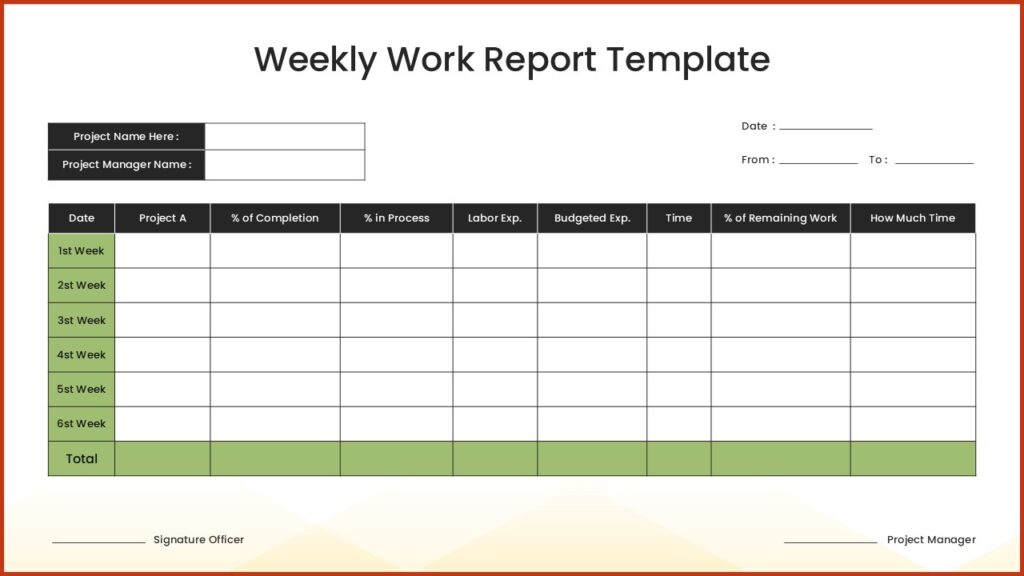
Below is a practical, fill-in-the-blank weekly report template. It is designed to work for most corporate roles and can be adapted to suit your specific context.
| Header | Weekly Report: [Your Name] | Week of [Date] to [Date] |
| Accomplishments this week | List 3 to 5 things you completed or made meaningful progress on. Lead with the most impactful item. Write outcomes, not just activities. Example: “Finalized the onboarding deck for the Q3 client cohort” rather than “Worked on the onboarding deck.” |
| Work in progress | List ongoing tasks with a brief status note. Example: “Market research for new product line (60% complete, on track for Friday submission).” |
| Plan for next week | List your top 3 to 5 priorities for the coming week. Be specific enough that your manager can identify any conflicts with team priorities. |
| Blockers and dependencies | What is slowing you down or holding up progress? Who do you need something from? If none, write “None this week.” |
| Key metrics (optional) | Include any numbers relevant to your role: sales, support tickets, pipeline value, campaign performance, and so on. |
| Decisions or support needed | If you need approval, input, or a decision from your manager or a colleague, list it here with context. Example: “Need sign-off on revised budget by Wednesday to proceed with vendor contract.” |
| Customization tip: The template above is a starting point. Adapt it to your role and your organization’s rhythm. A sales professional might lead with pipeline metrics. A developer might lead with sprint progress. A project manager might align the format with their project status reporting cadence. |
5. How to write a weekly report that gets noticed
Filling in a template is the easy part. Writing a report that is actually read, respected, and useful takes a little more thought. Here is how to do it.
- Write it on Friday, not Monday. The best time to write your weekly report is at the end of the week you are reporting on, while everything is still fresh. Monday morning recollection is notoriously unreliable. If your organization sends reports on Monday, draft them on Friday afternoon and review them first thing Monday.
- Keep a running log throughout the week. The most efficient weekly reporters do not write their report from scratch. They keep a running note during the week, jotting down accomplishments as they happen. By Friday, they are editing rather than remembering. A simple document, a note-taking app, or even a sticky note works.
- Lead with your most important accomplishment. Do not bury your headline. Your manager may skim the report. Put the thing you are most proud of, or the most strategically significant item, first.
- Be specific and concrete. Vague entries like “continued working on the project” tell the reader almost nothing. Specific entries like “completed first draft of the technical specification for the payment API, shared for review with the engineering team” are far more useful.
- Match the length to your audience. If your manager is extremely busy, keep it to half a page. If your weekly report is shared with a broader team, a bit more context may be appropriate. When in doubt, shorter is almost always better.
- Use consistent formatting every week. Consistency makes reports easier to scan. If your manager reads twenty reports a week, they will appreciate being able to find the “blockers” section in the same place every time. Pick a format and commit to it.
- Close with a clear ask if you have one. If you need something from your manager or a colleague, put it at the end in a dedicated section and be precise. “I need a decision on the vendor selection by Wednesday so I can finalize the contract” is far better than “let me know what you think.”
6. The biggest mistake: reporting activity instead of impact
The best weekly reporters report what they achieved. Here is the difference in practice.
| Activity-focused (weak) | Impact-focused (strong) |
| “Attended three client calls this week.” | “Held three client calls. Two resulted in upsell opportunities worth approximately $15,000 combined. One client raised a support issue that has been escalated to the product team.” |
| Activity-focused (weak) | Impact-focused (strong) |
| “Worked on the marketing campaign.” | “Completed copy and creative brief for the August email campaign. Handed off to design on Thursday, on track to launch by end of month.” |
| Activity-focused (weak) | Impact-focused (strong) |
| “Did a lot of research this week.” | “Completed competitive analysis of five SaaS vendors. Key finding: two have announced pricing changes that could affect our positioning. Summary shared with the team.” |
| Common mistake: Padding your weekly report with low-value activities to make a quiet week look busier than it was. Most managers can see through this immediately, and it erodes credibility. If it was a slower week, report accurately and focus on quality over quantity. |
7. Different types of weekly reports
The standard individual weekly report is the most common format, but weekly reporting takes different forms depending on the context. Here is a quick overview of the main types you are likely to encounter in a corporate environment.
Individual weekly report
Written by a single employee to their manager. Focused on personal accomplishments, priorities, and blockers. Usually one to two pages or a short email.
Team weekly report
A consolidated report covering the work of an entire team, usually compiled by the team lead or manager. Often combines individual inputs into a single document shared upward to department leadership.
Project weekly status report
Specific to a project rather than a role. It focuses on milestone progress, budget health, risks, and decisions needed for the project. If you are working on a discrete project with specific deliverables and stakeholders, this format is often more appropriate than a general individual weekly report.
Executive weekly report
A condensed, high-level summary intended for senior leadership. Less detail, more strategic framing. Typically no more than one page or five to six slides. Focuses on headline numbers, major milestones, and any items requiring executive attention or a decision.
Department or business unit weekly report
Covers an entire department’s performance for the week. Usually compiled by the department head and shared with the executive team or board. Includes aggregate metrics, team highlights, significant risks, and progress against quarterly or annual targets.
8. When your weekly report needs to be a presentation
In many organizations, weekly reports are not just written documents. They are presented in a weekly team meeting, a department standup, or an executive briefing. When that is the case, the quality of your slides matters just as much as the quality of your content.
Keep it to three to five slides
A weekly report presentation is not a strategy review. Three to five slides is the right target for most contexts. One slide for accomplishments, one for priorities and blockers, and one for metrics or key decisions is often all you need.
Use a consistent template every week
The template is the delivery mechanism. When your audience sees the same structure every week, they know exactly where to look for the information they care about. Changing your layout each week forces people to re-orient themselves rather than absorbing your content.
Let the visuals carry the structure
A well-designed weekly template uses visual hierarchy to make the most important information stand out. Section headers, color-coded status indicators, progress bars, and clean typography all help your audience process information faster.
Do not turn slides into documents
One of the most common mistakes in weekly presentations is putting too much text on each slide. Your slides should contain the key points. The detail and context should come from you, verbally. If someone needs to read the slide to understand what is happening, the slide has too much on it.
| The consistency principle: The best weekly report presenters have a template they never change. Their audience learns the structure, scans it in seconds, and knows immediately where to focus attention. A template that changes every week forces people to read rather than scan, which wastes everyone’s time. |
9. Using templates and tools to save time
One of the best investments you can make in your weekly reporting is finding a great template and sticking with it. A good weekly report template eliminates the blank-page problem, enforces consistency, and makes a polished impression without requiring design skills.
What makes a great weekly report template?
- A clear, consistent structure that covers accomplishments, priorities, blockers, and decisions needed
- Enough visual hierarchy that a reader can scan it in under 60 seconds
- Pre-built sections that prompt you to include the right information
- A professional design that reflects well on you regardless of the content
- Easy customization so you can adapt it to your role or organization’s preferences
Should you use a document or a slide deck?
This depends on how your organization works. If weekly reports are emailed, a well-formatted Word or PDF document is usually the right format. If they are presented in a meeting, a slide deck is more appropriate. Many professionals keep both: a short slide deck for the meeting, and a written summary sent by email afterward.
The case for a pre-built slide template
When your weekly report is a presentation, the slide template is the most important tool you have. A pre-built weekly report slide template gives you professionally designed layouts for every section, consistent typography and color, and purpose-built structures for things like metrics summaries and priority lists. You simply fill in your content and you are done.
| Recommended resource: SlidePick offers a collection of professionally designed weekly report templates built for corporate presentations. Whether you are reporting to your manager, presenting to your team, or briefing senior leadership, there is a template that fits. Visit slidepick.com to browse the full collection. |
Automating parts of the process
If you track your work in a project management tool like Asana, Jira, or Monday.com, many of these platforms can generate a summary of what was completed during the week. Use that summary as raw material for your weekly report rather than building it from memory.
Some teams use shared tools like Notion or Confluence to run weekly report templates collaboratively, where each team member fills in their section and the manager gets a consolidated view. If your team does not have this set up, it is worth suggesting, as the efficiency gains for the whole team are significant.
10. Quick-reference FAQ
How long should a weekly report be?
For most individual weekly reports, aim for half a page to one full page in written form. In slide form, three to five slides is the target. If your report regularly runs longer, you are likely including too much operational detail. Ask yourself: would my manager find this useful, or is it just for my own records?
What is the best day and time to send a weekly report?
End-of-week Friday afternoon or start-of-week Monday morning are the two most common conventions. If your organization does not have a standard, ask your manager which they prefer. Consistency matters more than the specific day.
What should I do when I have had a low-productivity week?
Report honestly. Do not pad the report with trivial activities. If the week was slow due to illness, a heavy meeting load, or waiting on dependencies, say so briefly. Your manager will appreciate the transparency, and it sets context for the coming week’s commitments. Everyone has quiet weeks, and those who handle them with honesty come across far better than those who obscure them.
Should my weekly report include personal context, like being on leave?
Yes, briefly. If you were out for part of the week, or if something personal has affected your output, a single sentence noting this is appropriate and professional. You do not owe detailed personal explanations, but flagging reduced output with a short note maintains transparency and avoids misunderstanding.
Do weekly reports replace one-on-ones with my manager?
No. Weekly reports are a complement to one-on-ones, not a replacement. The report creates a written record and keeps your manager informed between meetings. The one-on-one is where you discuss nuance, ask for feedback, and have conversations that do not translate well to a written format. Think of the report as the pre-read for the meeting.
What if my manager never reads my weekly reports?
Keep writing them. The discipline of producing a structured weekly summary has value even if your manager does not always read it. It sharpens your own thinking, creates a record you can use at review time, and demonstrates professionalism. If you genuinely suspect no one reads them, it is worth having a direct conversation with your manager about format or frequency, rather than stopping entirely.
Wrapping up
The weekly report is one of the most underestimated tools in a professional’s toolkit. Done well, it builds visibility, creates trust, surfaces problems early, and gives you a running record of your own growth. Done poorly, or not done at all, it leaves you invisible in a busy organization.
The good news is that a great weekly report does not require a lot of time. It requires a good template, consistent habits, and a commitment to writing about impact rather than activity. Get those three things right and your weekly report will work for you every single week.
And when it is time to present your weekly report in a meeting, make sure your slides are as sharp as your content. A professional, well-designed template takes the formatting work off your plate entirely so you can focus on what you actually want to say.
Explore weekly report templates at SlidePick.com.
Related Articles
 March 18th, 2026
15 Virtual Presentation Tips for Better Online Meetings
Business Presentation Tips- March 25th, 2026
What is a Project Status Report?
Business Presentation Tips - January 27th, 2026
How Do You Pitch a Business in 60 Seconds? The Complete Framework for Founders
Business Presentation Tips