- Why Pitch Deck Structure Matters More Than Design
- The 12-Slide Pitch Deck Structure: A Complete Breakdown
- Common Pitch Deck Mistakes That Cost Founders Funding
- How to Tailor Your Pitch Deck Structure by Stage
- Final Thoughts: Building a Pitch Deck That Investors Respect
- FAQ’S About a Strong Pitch Deck Structure


- Why Pitch Deck Structure Matters More Than Design
- The 12-Slide Pitch Deck Structure: A Complete Breakdown
- Common Pitch Deck Mistakes That Cost Founders Funding
- How to Tailor Your Pitch Deck Structure by Stage
- Final Thoughts: Building a Pitch Deck That Investors Respect
- FAQ’S About a Strong Pitch Deck Structure


If you have ever sat across from a venture capitalist and watched their eyes glaze over your slides, you already know that a pitch deck is not just a visual aid. It is your entire story, your credibility, and your ask, all compressed into a 10 to 15-minute window. I have spent years helping startup founders refine their investor pitch, and the single biggest mistake I see is a deck that lacks a clear, logical structure. Investors do not want to be confused. They want to be convinced. And that conviction starts with a pitch deck structure that flows the way their due diligence brain expects it to flow.
In this guide, I am walking you through the exact 12-slide pitch deck structure that investors look for, along with what to write on each slide, what to avoid, and how to make your pitch deck stand out in a room full of lookalike decks.
Why Pitch Deck Structure Matters More Than Design
Before we get into the slides themselves, I want to set the stage for why structure carries more weight than aesthetics. Most investors spend an average of under two minutes reviewing a pitch deck before deciding whether to move forward. That means your pitch deck structure has to do the heavy lifting before you even get into the room.
A strong pitch deck template is built like a story. It opens with tension (the problem), moves through resolution (your solution and business model), and closes with an invitation (the ask). When you structure a pitch deck this way, you are not just presenting information. You are guiding investors through a narrative that makes your startup the obvious, inevitable bet.
The best pitch decks I have reviewed all share one trait: every slide answers a question the investor was already forming in their head. That is not a coincidence. It is a deliberate structure.
The 12-Slide Pitch Deck Structure: A Complete Breakdown
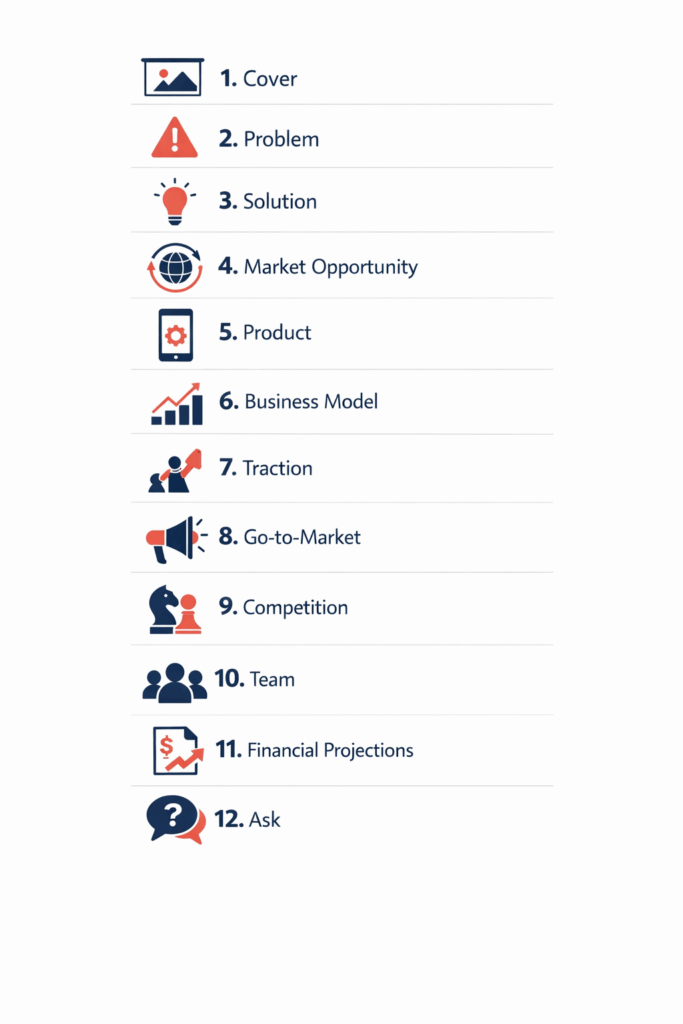
Slide 1: Cover Slide
Your cover slide sets the first impression. It should carry your company name, logo, tagline, and contact information. That is it. The biggest mistake startup founders make here is overloading the cover with copy. Keep it clean.
Your tagline should function like an elevator pitch in one sentence. Something like “Automated payroll for independent contractors” tells investors exactly who you serve and what you do. Compare that to “Revolutionizing financial ecosystems through AI-powered synergies,” and you will immediately understand why simplicity wins.
This slide is also where investors decide if your deck design signals professionalism. Use consistent fonts, clear visuals, and intentional whitespace. If your cover slide looks thrown together, investors will assume the pitch will too.
What investors want to see: Your company name, a clear one-line value proposition, and a visual identity that looks intentional and concise.
Slide 2: Problem Slide
Every pitch deck structure begins with the problem, and this slide is arguably the most important one in your deck. If investors do not believe the problem is real, painful, and widespread, nothing that follows will matter.
I always advise founders to be specific. Do not say “small businesses struggle with accounting.” Say “Over 60% of small business owners spend more than 5 hours per week on manual bookkeeping, leading to an average of $12,000 per year in accounting errors.” That kind of specificity signals market research, and it immediately makes the investor feel the urgency.
A strong problem slide identifies who is affected, quantifies how much it costs them (in time, money, or both), and makes clear why existing solutions fall short. This is your chance to convince investors that the pain is real and that the market is waiting for someone to solve it.
What investors want to see: A specific, quantified pain point with a clear target customer and evidence that current solutions are inadequate.
Slide 3: Solution Slide
After you have established the problem, your solution slide needs to deliver the relief. This is where you introduce your product or service as the direct answer to everything you just described. The best solution slides I have seen do not try to explain every feature. They communicate one clear outcome.
Think about it from the investor’s perspective. They are not buying a product. They are buying the result that the product creates. If your problem slide showed that property managers lose $15,000 a year to maintenance delays, your solution slide should show how your software eliminates those delays, not how many buttons are on your dashboard.
Use visuals, screenshots, or a simple demo to make this tangible. Text-heavy solution slides lose investors fast. Show, do not tell, and keep it focused on the unique value proposition your product delivers.
What investors want to see: A clear answer to the problem you just raised, communicated visually, with a focus on outcome rather than features.
Slide 4: Market Opportunity Slide
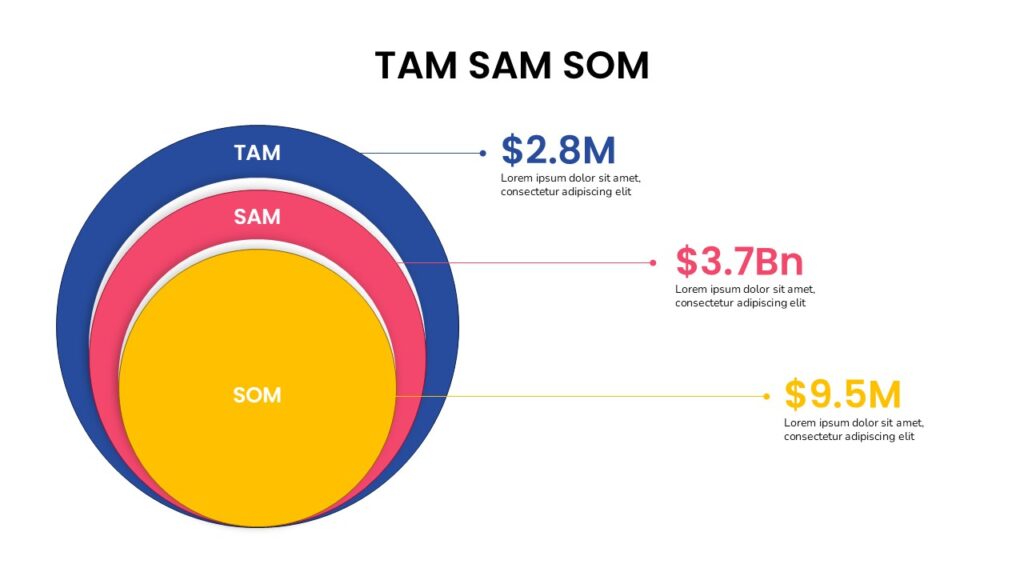
View This TAM SAM SOM Infographic
This is where you prove that solving this problem is worth a venture-scale investment. Your market opportunity slide needs to present your total addressable market (TAM), serviceable addressable market (SAM), and serviceable obtainable market (SOM) in a way that feels grounded and realistic.
The biggest mistake I see founders make on this slide is citing a massive top-down market size without any explanation of how they get there. Saying your market is “$500 billion globally” without context invites skepticism. Investors want to see bottom-up market sizing that is built from unit economics: how many potential customers exist, what you charge per customer, and what a realistic capture rate looks like.
A well-built market opportunity slide demonstrates that you understand the market deeply, that there is enough room to build a significant business, and that you have thought seriously about where you fit within the broader landscape. Potential investors respond to founders who can defend their numbers in the room.
What investors want to see: A credible, bottom-up market size calculation with a clear path from TAM to realistic revenue potential.
Slide 5: Product or Service Slide
By this point in your pitch deck, investors understand the problem and the market. Now they want to see what you have actually built. Your product or service slide is your chance to make the solution feel real and differentiated.
Use screenshots, mock-ups, or a short demo to show the product in action. If you are pre-product, use wireframes or a prototype walkthrough. The goal here is to highlight key features that directly address the pain point you identified in slide two, not to give a comprehensive product tour.
I also recommend highlighting any proprietary technology, defensible IP, or unique technical advantages on this slide. These details help investors understand why this product or service is difficult to replicate, which directly supports your competitive moat. If your solution is built on something others cannot easily copy, this is where you say so.
What investors want to see: A visual demonstration of your product or service with clear connections between key features and the problem you are solving.
Slide 6: Business Model Slide
Your business model slide answers one of the most fundamental investor questions: how does this company make money? This slide should be clear, direct, and free of jargon.
Describe your revenue model, whether that is a subscription, transactional, licensing, marketplace, or another structure. Include your pricing strategy and, if available, your unit economics, including customer acquisition cost (CAC), lifetime value (LTV), and gross margins. These numbers tell investors whether the business is built to scale profitably.
A strong business model slide also gives investors a sense of customer acquisition. How do you reach your customers? What channels drive growth? What does the economics of one customer look like from first touch to long-term retention? These are the details that separate a compelling story from a convincing business plan.
What investors want to see: A clear explanation of how you make money, with pricing, unit economics, and at least a high-level view of your customer acquisition model.
Slide 7: Traction Slide
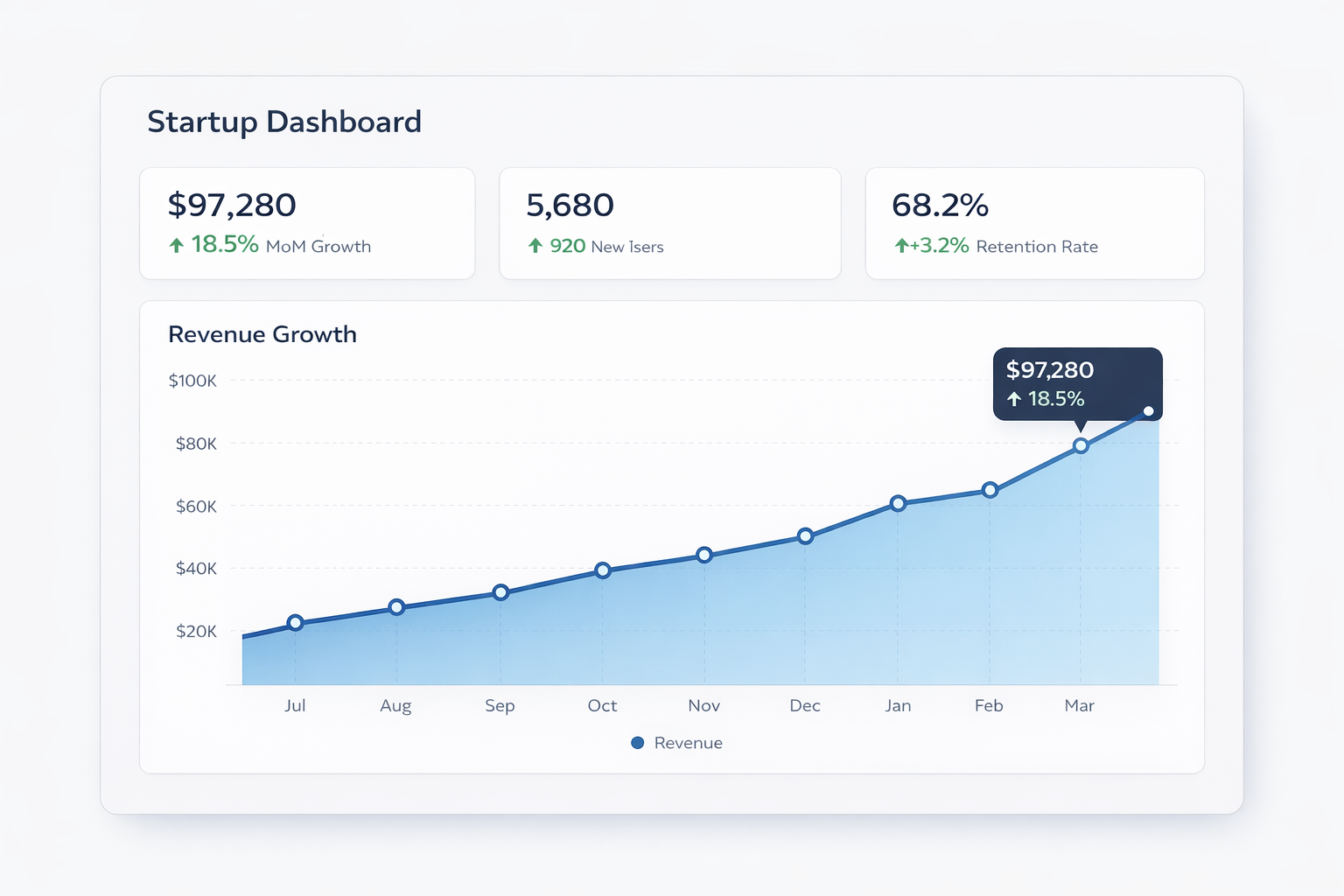
Nothing makes investors lean forward more than traction. This slide is your proof that the market is responding. Whether you have revenue, users, pilots, letters of intent, partnerships, or notable growth metrics, show them here.
Traction does not have to mean millions in revenue. At the early stage, even a compelling waitlist, a strong month-over-month growth rate, or a signed pilot with a recognizable brand can signal that the idea has legs. What matters is showing forward momentum and demonstrating that real customers have validated your value proposition.
Show your traction visually. A chart trending upward communicates more than a bullet point ever will. If you have retention metrics, show those too. Investors want to see not just that people tried your product or service, but that they kept using it.
What investors want to see: Concrete evidence of market demand, including revenue, user growth, retention, key partnerships, or other signals that customers value what you have built.
Slide 8: Go-to-Market Slide
Having a great product or service is not enough. Investors want to know how you plan to get it into the hands of paying customers at scale. Your go-to-market slide outlines your strategy for customer acquisition and growth.
This slide should cover your primary distribution channels, your marketing strategy, your sales motion, and your early traction in each channel. It should also touch on any strategic partnerships that will accelerate customer acquisition or reduce costs.
Be honest here. Founders who claim they will grow through “viral word of mouth and partnerships” without specifics lose credibility fast. Show investors that you have tested channels, that you know your CAC by channel, and that you have a roadmap for scaling what is already working. A strong go-to-market strategy is often what separates the startups that raise from the ones that do not.
What investors want to see: A specific, channel-by-channel customer acquisition plan with evidence that at least one channel is already producing results.
Slide 9: Competition Slide
Every startup has competition, even if that competition is a spreadsheet or a manual process. Trying to tell investors you have no competitors is one of the fastest ways to lose their trust. Your competition slide needs to show that you understand the competitive landscape and that you have a defensible advantage within it.
The most effective format I have seen is a 2×2 or axis-based competitive matrix that positions your company against the most relevant alternatives on the dimensions that matter most to your customer. Do not choose dimensions just to make yourself look good. Choose the axes that your target customer actually uses to make purchasing decisions.
Your competition slide should end with a clear statement of your unique value proposition and what makes your approach meaningfully different. Whether that is your technology, your business model, your team, your network, or your customer relationships, make it explicit. Show investors why customers will choose you over the next best alternative every time.
What investors want to see: An honest, well-researched map of the competitive landscape with a clear and defensible explanation of your sustainable advantage.
Slide 10: Team Slide
Investors often say they bet on the jockey, not the horse. Your team slide is where you make the case that the people behind this startup are uniquely qualified to solve this problem and capture this market.
Highlight the founders and key team members with a focus on domain expertise, relevant experience, and any prior startup successes. If you have advisors, investors, or board members with strong credentials, include them here. Social proof from respected names in your industry can meaningfully increase investor confidence.
Be selective. Do not list every employee. Focus on the people whose backgrounds most directly connect to the problem you are solving and the challenges you will face scaling the business. A team slide that shows deep domain expertise, complementary skill sets, and a track record of execution is one of the strongest elements of a winning pitch deck.
What investors want to see: A tight, credible team with directly relevant experience, ideally backed by advisors or existing investors who add credibility and network value.
Slide 11: Financial Projections Slide
Your financial projections slide does not need to be a 50-tab spreadsheet. What investors want to see is that you understand your business model deeply enough to build a credible three to five-year financial forecast that connects to your assumptions.
Include your projected revenue, key cost drivers, burn rate, gross margins, and the timeline to profitability or cash flow breakeven. If you are at the pre-seed stage, keep this high-level and focus on showing your thinking around unit economics and the key levers that drive growth.
What investors are really evaluating here is not whether your exact numbers will come true, but whether you understand the financial architecture of your business. Can you speak to the assumptions behind your projections? Can you explain what changes if your CAC is 20% higher than expected? The founders who can answer those questions fluently are the ones who build investor confidence at this stage.
What investors want to see: A clear, well-reasoned financial model with realistic projections, transparent assumptions, and a logical path to profitability.
Slide 12: The Ask Slide
Your ask slide closes your pitch deck with a clear, specific funding request. This is where many founders become vague, which is a mistake. Tell investors exactly how much you are raising, what structure you are using (equity, SAFE, convertible note), and what you plan to do with the capital.
Break the use of funds into clear categories: product development, hiring, marketing, operations, and any other major buckets. Then connect those allocations to specific milestones you plan to hit with the raise. Investors want to understand what this capital buys in terms of progress and what the key proof points will be before your next round.
A strong ask slide also sets the stage for ongoing dialogue. It shows investors that you are disciplined, that you have thought carefully about your roadmap, and that you are ready to accomplish specific, measurable things, not just to extend runway indefinitely.
What investors want to see: A specific funding amount with a clear use of funds breakdown and a milestone-based roadmap that shows exactly what this capital will help you achieve.
Common Pitch Deck Mistakes That Cost Founders Funding
Even with the right pitch deck structure, execution mistakes can derail an otherwise strong pitch. Here are the most common problems I see:
Too many slides: The standard 12-slide format exists for a reason. Every additional slide dilutes your message and tests investor patience. If you cannot tell your story in 12 to 15 slides, you need to sharpen your narrative, not add more slides.
Weak problem framing: A vague problem statement kills momentum before it starts. Quantify the pain. Show the cost. Name the specific customer who is suffering. The more precisely you define the problem, the more credible your solution becomes.
No traction: If you have early evidence of demand, lead with it. If you do not have any traction yet, focus on making your team slide and your market opportunity as compelling as possible. Investors’ fund conviction, and conviction comes from proof or people.
Cluttered design: A well-structured pitch deck should be easy to skim. One idea per slide. Clear headlines. Minimal text. Visuals over bullet points wherever possible. Deck design should support your message, not compete with it.
Vague ask: Never walk into a pitch without a specific number. An investor who has to ask “how much are you raising?” has already lost a little confidence in the founder. Know your number, own it, and be prepared to defend the assumptions behind it.
How to Tailor Your Pitch Deck Structure by Stage
Not every pitch deck template works for every stage. Here is how I think about adjusting the structure based on where you are in the fundraising journey.
Pre-seed: At this stage, you are selling vision and team more than metrics. Your problem, solution, and team slides carry the most weight. Traction may be limited, so focus on validating the market and showing that your founding team has a unique insight into the problem. Keep financial projections simple and focused on your 18-month plan.
Seed: By the seed stage, investors want to see an early signal. You should have some traction, whether that is revenue, users, pilots, or retention data, and your business model should be clearly defined. This is also the stage where your go-to-market strategy starts to matter a great deal.
Series A: At this point, the pitch deck is built almost entirely on proof. Strong revenue growth, clear unit economics, a proven go-to-market motion, and a team with the capacity to scale. Financial projections need to be detailed and defensible, and your competition slide needs to show a widening moat.
Final Thoughts: Building a Pitch Deck That Investors Respect
The best pitch deck is not the prettiest one or the longest one. It is the one that tells a compelling story in the order investors expect, with the evidence they need, and the clarity that makes them say yes.
I have seen founders with average products raise significant rounds because their pitch deck structure was tight, their narrative was clear, and their ask was precise. I have also seen brilliant ideas fail to attract a single investor because the deck was a mess of information with no story holding it together.
Use this 12-slide structure as your foundation. Customize it to your business, your stage, and your strengths. But whatever you do, make sure every slide earns its place, and every slide answers the question the investor is already forming in their head.
That is what a winning pitch deck looks like. That is the structure investors expect. And that is how you give your startup the best possible shot at the funding it deserves.
Ready to build your pitch deck? Start with slide one, your cover, and work through each slide in the order outlined above. The structure is your roadmap. The story is yours to tell.
FAQ’S About a Strong Pitch Deck Structure
A: Most investors prefer a concise pitch deck with 10 to 12 slides. A well-structured pitch deck template covering problem, solution, traction, and ask gives investors everything they need without overwhelming them. Many pitch decks that successfully raised funding, including famous ones from Airbnb and Dropbox, stayed within this range.
A: To create a pitch deck that converts, structure your pitch deck around a strong narrative, lead with a specific problem, back every claim with real examples and data, and close with a clear ask. Investors respond to founders who can tell a compelling story while showing strong traction and a defensible business model.
A: Investors want to see that you understand the full competitive landscape and have a unique value proposition that is difficult to replicate. A strong competition slide uses a visual matrix to show investors understand where they win, and includes a concise explanation of your sustainable competitive advantage versus every existing alternative.
A: Yes. Many investors review a pitch deck cold before agreeing to a meeting. When you send your deck without a prior conversation, make sure your cover slide tagline, problem framing, and traction slide do the heavy lifting. A well-structured pitch deck must communicate your entire story clearly, even without you in the room to present it.
Related Articles
 January 12th, 2026
Mock Presentation Best Practices for Feedback, Evaluation & Effective Delivery
Business Presentation Tips- March 25th, 2026
Post Mortem Meeting Agenda: A Complete Guide for Teams
Business Presentation Tips - April 2nd, 2026
How to Write a Self-Appraisal for an Annual Performance Review (Step-by-Step Guide)
Business Presentation Tips