- What Is an Individual Development Plan?
- Why Individual Development Plans Matter (For Employees and Managers)
- Key Components of an Effective Individual Development Plan
- How to Create an Individual Development Plan: Step-by-Step
- How to Write SMART Goals for Your Individual Development Plan
- Individual Development Plan Examples by Role
- Common Mistakes to Avoid When Creating an IDP
- Individual Development Plan vs. Performance Review: Understanding the Difference
- A Manager’s Guide to Supporting Employee Development Plans
- Individual Development Plans for Remote and Hybrid Teams
- Frequently Asked Questions About Individual Development Plans
- Final Thoughts: Your Development Plan Is Worth the Effort
Individual Development Plan: A Complete Guide to Building One That Actually Works

- What Is an Individual Development Plan?
- Why Individual Development Plans Matter (For Employees and Managers)
- Key Components of an Effective Individual Development Plan
- How to Create an Individual Development Plan: Step-by-Step
- How to Write SMART Goals for Your Individual Development Plan
- Individual Development Plan Examples by Role
- Common Mistakes to Avoid When Creating an IDP
- Individual Development Plan vs. Performance Review: Understanding the Difference
- A Manager’s Guide to Supporting Employee Development Plans
- Individual Development Plans for Remote and Hybrid Teams
- Frequently Asked Questions About Individual Development Plans
- Final Thoughts: Your Development Plan Is Worth the Effort


If you have ever sat through a performance review and thought, “I want to grow here, but I have no idea where to start”, you are not alone. That feeling is more common than most people admit. The good news? An individual development plan (IDP) can change that. It turns vague career ambitions into a concrete, working roadmap you can actually follow.
This guide walks you through everything you need to know about creating an individual development plan, from understanding what it is, to building one from scratch, to using a ready-made presentation template that saves you hours of work. Whether you are an employee looking to level up or a manager helping your team grow, this is the guide for you.
What Is an Individual Development Plan?
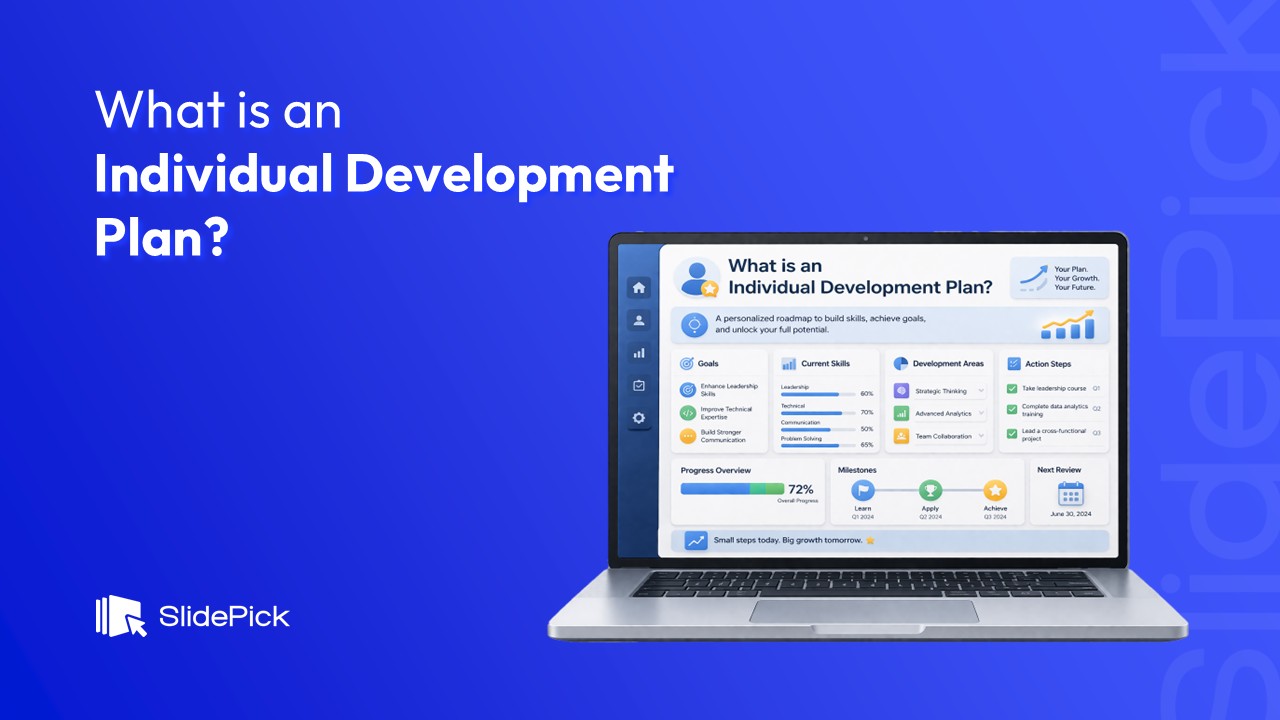
An individual development plan, commonly called an IDP, is a structured document that outlines an employee’s professional goals, the skills they want to develop, and the specific steps they will take to get there. It is a living document, meaning it grows and changes alongside the person using it.
Think of it less like a rigid contract and more like a conversation on paper. It captures where you are right now, where you want to go, and the honest gap between the two.
IDPs are used across industries from tech companies and healthcare organizations to nonprofits and government agencies. They are used by entry-level employees figuring out their first career moves as well as senior leaders preparing for executive roles.
Key Insight: An individual development plan is not a performance improvement plan (PIP). A PIP is reactive: it addresses problems. An IDP is proactive: it focuses on potential and growth.
Why Individual Development Plans Matter (For Employees and Managers)
You might be wondering: why go through the effort of creating a formal plan? Can’t people just… grow naturally on the job?
Sure, some growth happens organically. But without a plan, it tends to be slow, scattered, and dependent on luck. An IDP changes that dynamic entirely.
For Employees
- Gives your career goals a clear structure
- Helps you identify skill gaps before they become roadblocks
- Creates a record of your growth to reference during performance reviews
- Builds accountability: it is easy to drift when there is no written plan
- Opens the door to mentorship and learning opportunities you might not have known to ask for
For Managers and HR Teams
- Aligns employee growth with organizational goals
- Improves retention: employees who feel invested in are more likely to stay
- Creates a shared language between managers and direct reports during 1-on-1s
- Helps identify high-potential employees earlier
- Supports succession planning across departments
The data backs this up too. Research consistently shows that employees who have access to professional development opportunities are more engaged, more productive, and significantly less likely to leave their organizations. An IDP is one of the most tangible ways to make that investment visible and real.
Key Components of an Effective Individual Development Plan
Not all IDPs are created equal. A strong individual development plan typically includes the following core components:
1. Current Role and Responsibilities
Start with where you are right now. Document your current job title, your main responsibilities, and your key strengths. This gives context for everything that follows.
2. Career Goals
This is the heart of the IDP. What do you actually want? Be honest here — not just with your manager, but with yourself. Maybe you want to move into leadership. Maybe you want to become a technical expert in a specific domain. Maybe you want to pivot to an entirely different function. Write it down.
Goals should be broken into short-term (next 6-12 months) and long-term (1-3 years or beyond). Both matter.
3. Skills and Competency Assessment
List the skills, knowledge areas, and behaviors that are required for your target role. Then honestly assess where you stand on each one. This gap analysis is where the real insight lives.
4. Development Activities
This is the action section. For each skill gap, identify specific learning activities. These might include:
- Taking an online course or certification program
- Attending industry conferences or workshops
- Reading specific books, articles, or case studies
- Shadowing a colleague in a role you aspire to
- Taking on a stretch assignment or cross-functional project
- Working with a mentor or executive coach
- Presenting at team meetings to build communication skills
5. Timeline and Milestones
Do not skip this part — it is what separates a wishlist from an actual plan. Attach specific dates to each development activity. When will you start? When will you complete it? When will you check in on your progress?
6. Resources Needed
What do you need to make this happen? This could include budget for a training course, time off for a conference, access to a particular tool, or support from a specific person.
7. Success Metrics
How will you and your manager know you have succeeded? Define what progress looks like. This makes your development plan measurable and keeps it grounded.
8. Review Schedule
An IDP should not live in a drawer. Build in regular check-ins, quarterly is typical, to assess progress, adjust goals, and celebrate wins.
How to Create an Individual Development Plan: Step-by-Step
Ready to build your own? Here is a practical, step-by-step walkthrough.
Step 1: Reflect on Where You Are and Where You Want to Go
Before you open a template or schedule a meeting, spend some time thinking. Seriously, just sit with it. What parts of your current role energize you? What drains you? Where do you see yourself in three to five years? What kind of work would feel meaningful?
Journaling, talking with a trusted peer, or even taking a strengths assessment like CliftonStrengths or the VIA Character Strengths survey can help you clarify your thinking before you formalize anything.
Step 2: Review Your Organization’s Competency Framework
Most companies have a defined set of competencies or behaviors expected at each level. Find out what is expected for your current level and the level you are targeting. This gives your development plan an anchor in business reality, not just personal preference.
Step 3: Have an Honest Conversation with Your Manager
This step makes a lot of people nervous. That is understandable. But your manager is a critical partner in your development, and most managers genuinely want to help their people grow. Schedule a dedicated conversation, share your goals openly, and ask for their honest perspective on your strengths and development areas.
Questions worth asking in that conversation:
- What do you see as my biggest strengths?
- Where do you think I have the most room to grow?
- What would need to be true for me to be considered for [target role]?
- Are there any projects or opportunities coming up that could help me build toward that?
Step 4: Identify Your Top 2-3 Development Priorities
You cannot develop everything at once. After your self-reflection and manager conversation, narrow your focus to two or three key areas. Trying to work on ten things simultaneously usually means making meaningful progress on none of them.
Step 5: Map Out Specific Actions
For each development priority, brainstorm at least three concrete activities. Then choose the ones that are most realistic given your time, resources, and learning style. People learn differently, some people thrive in formal courses while others learn best by doing. Design your IDP accordingly.
Step 6: Set Realistic Timelines
Assign a start date, an end date, and at least one mid-point check-in to each activity. Use specific dates, not vague language like “by end of year.” The more specific you are, the more accountable you become.
Step 7: Put It in Writing and Share It
A plan that exists only in your head is not really a plan. Document your IDP in a format you can share with your manager and revisit regularly. This brings us to something worth mentioning…
Pro Tip: One of the most common reasons IDPs go unused is that they are buried in a clunky form or a document no one enjoys opening. A well-designed presentation makes your IDP more engaging, easier to share, and more likely to be revisited. Use a website like SlidePick to get presentation templates that do the heavy lifting for you — so you can focus on the content, not the formatting.
Step 8: Schedule Regular Reviews
Put your IDP review dates in your calendar right now. Quarterly check-ins are ideal. Use that time to assess what you have completed, what has shifted, and what needs to be updated.
How to Write SMART Goals for Your Individual Development Plan
Goals that are too vague are almost impossible to act on. The SMART framework is a reliable way to write goals that actually drive progress.
SMART stands for:
- Specific: What exactly do you want to achieve?
- Measurable: How will you track progress and know when you have succeeded?
- Achievable: Is this realistic given your current resources and constraints?
- Relevant: Does this goal align with your broader career direction and your organization’s needs?
- Time-bound: What is the deadline?
Example: Vague Goal vs. SMART Goal
Vague: “I want to get better at public speaking.”
SMART: “By June 30, I will deliver three internal presentations to groups of 10 or more people and receive peer feedback on my delivery and clarity after each session.”
See the difference? The SMART version tells you exactly what you are doing, how you will measure it, and when it needs to happen. That specificity is what makes it actionable.
Individual Development Plan Examples by Role
Context matters when building an IDP. Here are a few examples to illustrate how plans might look across different roles and goals.
Example 1: Software Engineer Aiming for a Senior Role
Goal: Transition from mid-level to senior software engineer within 18 months.
Development Areas: System design, technical leadership, mentoring junior engineers.
Key Activities:
- Complete a system design course (target: 3 months)
- Lead the architecture discussion on one project per quarter
- Mentor one junior developer through weekly 30-minute check-ins
- Present a technical deep-dive to the engineering team once per quarter
Example 2: Marketing Manager Developing Leadership Skills
Goal: Build people management skills to prepare for a Director-level role.
Development Areas: Coaching, delegation, conflict resolution, strategic thinking.
Key Activities:
- Enroll in a leadership development program (start within 60 days)
- Lead weekly team stand-ups and own the agenda
- Shadow the current Director during quarterly business reviews
- Read two books on management per quarter; share summaries with the team
Example 3: Customer Success Specialist Pivoting to Product
Goal: Move into a product management role within 2 years.
Development Areas: Product thinking, data analysis, stakeholder management, Agile methodology.
Key Activities:
- Complete a product management certification (e.g., Product School, Pragmatic Institute)
- Request to be embedded with the product team on one sprint per quarter
- Learn SQL basics through an online course in the next 4 months
- Document customer feedback in a structured way and present insights to the product team monthly
These examples are meant to spark ideas and not to be copied verbatim. Your IDP should reflect your specific situation, your organization’s context, and your own ambitions. No two IDPs look exactly alike, and that is kind of the point.
Common Mistakes to Avoid When Creating an IDP
Even well-intentioned IDPs can fall apart. Here are the most common pitfalls and how to avoid them.
Setting Too Many Goals
This is probably the most common mistake. People get excited during goal-setting season and commit to six or seven big development areas at once. Three months later, they have made no real progress on any of them because there was never enough focused time or energy. Prioritize ruthlessly. Two or three meaningful goals will always outperform a long list of aspirations.
Being Too Vague
“I want to improve my communication skills” is not a development goal, it is a wish. Use the SMART framework to turn fuzzy ideas into concrete actions.
Treating It as a One-Time Document
An IDP that gets created in January and never looked at again is not doing anyone any good. Build in your review dates from day one.
Leaving the Manager Out
Your IDP should not be a solo exercise. Your manager has visibility into opportunities you may not know about, and their support is often what determines whether you get access to the stretch projects, training budgets, and introductions that make development possible.
Focusing Only on Weaknesses
Here is something that often gets overlooked: the most powerful development does not always come from fixing your weaknesses. Sometimes it comes from deepening your strengths. Both have a place in a well-balanced IDP. Do not turn your development plan into a list of things that are wrong with you.
No Ownership or Accountability
Ultimately, your development is your responsibility. Managers can support and enable it, but they cannot do it for you. Own your IDP like you own your results.
Individual Development Plan vs. Performance Review: Understanding the Difference
These two things are related but they are not the same, and confusing them can undermine the effectiveness of both.
Performance reviews look backward. They assess what you accomplished over a defined period, how you performed against goals, and whether you met expectations.
Individual development plans look forward. They focus on where you are going, what you need to learn, and how you plan to get there.
A good performance review process should feed into your IDP. The feedback you receive on your strengths and development areas naturally informs the goals you set. But they serve different purposes and should be treated as separate conversations, even when they happen at the same time of year.
A Manager’s Guide to Supporting Employee Development Plans
If you manage a team, here is how you can make IDPs genuinely useful for your people, rather than just another HR checkbox.
Create Psychological Safety Around the Process
Employees need to trust that sharing their real goals, including goals that might take them to a different team or even a different company someday will not be held against them. Create that trust by being open yourself. Share your own development goals when appropriate. Model what honest growth-focused conversation looks like.
Ask Good Questions
The best IDP conversations are driven by curiosity, not interrogation. Some useful questions to explore with your team members:
- What kind of work do you find most energizing right now?
- Where do you feel like you are being stretched in a good way?
- Is there anything about your current role that feels limiting?
- What does success look like for you in the next year?
- Is there someone in the organization whose career path you admire?
Connect Development to Opportunity
This is where managers have enormous leverage. You often have visibility into upcoming projects, initiatives, or organizational changes that could serve as perfect development opportunities for your team members. When you see a connection between a development goal and a real opportunity, make it. That is where IDPs come to life.
Follow Through on Commitments
If you agree to introduce your employee to a senior leader, provide budget for a course, or revisit something in the next check-in, do it. Nothing undermines an IDP faster than a manager who does not follow through on the support they offered.
Celebrate Progress, Not Just Completion
Development is rarely linear. Acknowledge the effort and the small wins along the way, not just when someone hits a big milestone.
Individual Development Plans for Remote and Hybrid Teams
Remote and hybrid work has changed how development conversations happen, and in some ways, it has made IDPs more important than ever.
When you are not in the same office, it is easier for career development to slip through the cracks. Out of sight can mean out of mind when it comes to stretch assignments, mentorship, and visibility with senior leaders. A well-documented IDP helps bridge that gap.
For remote teams specifically, consider these adjustments:
- Make your IDP more visual and shareable, a well-designed presentation (hint: SlidePick is great for this) makes it easier to discuss asynchronously
- Schedule dedicated development conversations separate from project update calls
- Lean more heavily on online learning resources, virtual mentoring, and digital communities of practice
- Use shared documents or collaboration tools to track IDP progress in real time
- Be intentional about creating visibility, remote employees often have to work harder to demonstrate growth and be considered for new opportunities
Frequently Asked Questions About Individual Development Plans
How long should an individual development plan be?
There is no single right answer, but most effective IDPs are concise. A one to two page document or a short presentation with five to eight slides is usually enough. The goal is clarity and usability, not comprehensiveness. If your IDP is so long that no one reads it, it is too long.
How often should an IDP be updated?
Quarterly reviews are the most common cadence, and they tend to work well. That said, life changes — and so do careers. If something major shifts (a reorganization, a new manager, a change in your goals), revisit your IDP sooner rather than later. It is a living document, not a contract carved in stone.
What is the difference between an IDP and a PDP?
A Personal Development Plan (PDP) is a broader term often used interchangeably with IDP. In some organizations, PDPs are used in educational or personal growth contexts while IDPs are more specifically workplace-focused. Functionally, they serve the same core purpose: setting intentional goals and identifying the actions needed to achieve them.
Can an IDP include goals outside my current role?
Yes and in many cases it should. Long-term career goals naturally point beyond your current position. A good IDP acknowledges where you are going, even if getting there requires moving into a different role, team, or even organization.
Who owns the IDP — the employee or the manager?
The employee owns it. The manager is a collaborator and supporter, not the author. This distinction matters because it puts the responsibility for growth where it belongs: with the person doing the growing. When employees feel ownership over their development plan, they are far more likely to follow through on it.
Is there a standard IDP format?
No universal standard exists, but most effective IDPs cover the same core elements: current role assessment, career goals, skill gaps, development activities, timeline, and success metrics. The format can vary: a document, a spreadsheet, or a presentation all work. The most important thing is that you actually use it.
How do I make my IDP presentation-ready?
Use a structured template that organizes your information clearly. SlidePick’s pre-built individual development plan template is designed specifically for this purpose. It gives you a professional, clean starting point so you can focus on your content without worrying about design.
Final Thoughts: Your Development Plan Is Worth the Effort
Building an individual development plan takes time and honesty. It requires you to look clearly at where you are, get specific about where you want to go, and commit to the work it will take to bridge that gap. None of that is trivial.
But here is what is also true: the people who invest in their own development consistently outpace those who do not. Not because they are necessarily more talented — but because they are more intentional. They know what they are working toward. They have a plan. And plans, when followed, produce results.
Your career is one of the most important long-term projects you will ever work on. An individual development plan is how you manage it with purpose and clarity rather than leaving it to chance.
And if you want to make the process a little smoother and a lot more visually polished, SlidePick’s pre-built IDP presentation template is ready when you are. It takes the formatting work off your plate so you can focus on what matters most — actually building the plan.
Get started today. Your future self will thank you for it.
Related Articles
 January 3rd, 2026
Create a High-Conversion Sales Pitch Presentation in 2026
Business Presentation Tips- March 18th, 2026
15 Virtual Presentation Tips for Better Online Meetings
Business Presentation Tips - March 25th, 2026
The Complete Guide to Weekly Reports (with Templates)
Business Presentation Tips