- What Is a Skills Gap Analysis?
- Why Does a Skills Gap Analysis Matter?
- Skills Gap Analysis vs. Competency Gap Analysis: What Is the Difference?
- Common Types of Skills Gaps Organizations Face
- How to Conduct a Skills Gap Analysis: A Step-by-Step Process
- Tools and Templates for a Skills Gap Analysis
- How to Present Your Skills Gap Analysis Results
- Common Mistakes to Avoid in a Skills Gap Analysis
- How Often Should You Conduct a Skills Gap Analysis?
- Get a Head Start with a Skills Gap Analysis Presentation Template
- Frequently Asked Questions About Skills Gap Analysis
- Final Thoughts
What Is a Skills Gap Analysis? A Complete Step-by-Step Guide

- What Is a Skills Gap Analysis?
- Why Does a Skills Gap Analysis Matter?
- Skills Gap Analysis vs. Competency Gap Analysis: What Is the Difference?
- Common Types of Skills Gaps Organizations Face
- How to Conduct a Skills Gap Analysis: A Step-by-Step Process
- Tools and Templates for a Skills Gap Analysis
- How to Present Your Skills Gap Analysis Results
- Common Mistakes to Avoid in a Skills Gap Analysis
- How Often Should You Conduct a Skills Gap Analysis?
- Get a Head Start with a Skills Gap Analysis Presentation Template
- Frequently Asked Questions About Skills Gap Analysis
- Final Thoughts


If you have ever sat in a meeting and quietly wondered why your team keeps hitting the same walls over and over, there is a good chance you are dealing with a skills gap. It is one of those problems that does not always look like a problem at first. Projects stall, deadlines slip, certain tasks keep getting handed off to the same two or three people.
Sound familiar?
A skills gap analysis is the structured process of figuring out exactly where those gaps live.
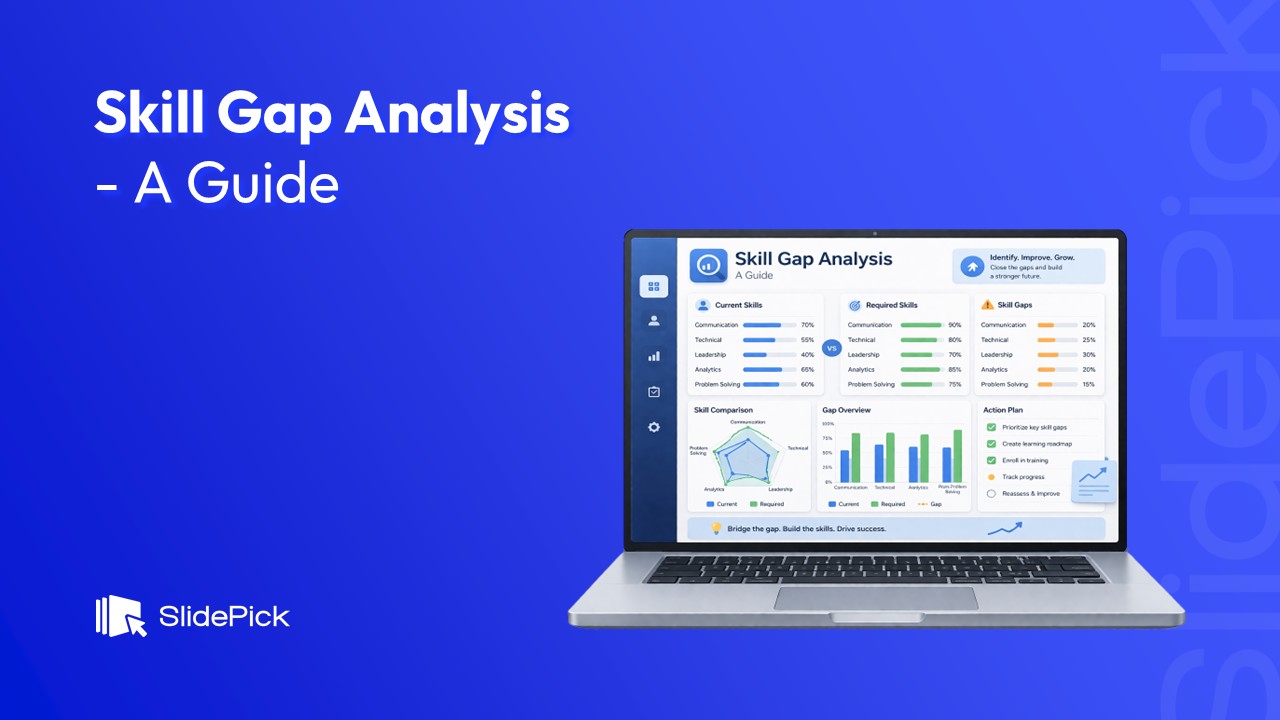
It compares the skills your organization currently has against the skills it actually needs to hit its goals, and then it gives you a clear picture of what needs to change. Whether you are an HR professional, a team lead, a learning and development manager, or a business owner, running a skills gap analysis is one of the smartest investments you can make in your workforce.
This guide covers everything you need to know: what a skills gap analysis is, why it matters, how to run one from start to finish, and how to present your findings in a way that actually gets people to pay attention.
And yes, we will also point you to a resource that can save you a few hours of work once you get to the presentation stage.
What Is a Skills Gap Analysis?
A skills gap analysis is a systematic method used by organizations to identify the difference between the skills employees currently possess and the skills required to meet business objectives. Think of it as a diagnostic tool. You are not just listing what people can and cannot do. You are mapping the distance between where your workforce stands today and where it needs to be tomorrow.
The “gap” in skills gap analysis refers specifically to the space between two things:
- Current skills: What your employees, teams, or organization can do right now
- Required skills: What your employees, teams, or organization needs to be able to do to meet goals, remain competitive, and grow
When you close that gap, things start to click. Teams perform better. Hiring becomes more targeted. Training stops being a checkbox and starts being something that actually moves the needle.
A skills gap analysis can be conducted at multiple levels:
- Individual level: Focused on a single employee’s skills versus what their role demands
- Team level: Looking at the collective capabilities of a department or project team
- Organizational level: A company-wide view of skills availability versus strategic needs
Why Does a Skills Gap Analysis Matter?
Here is the honest truth: most organizations are operating with some version of a skills gap right now. The question is just whether they know it.
According to the World Economic Forum’s Future of Jobs Report, over 50% of all employees will require significant reskilling or upskilling by the end of this decade. The pace of technology adoption, automation, and market evolution means that the skills that got your company here may not be the ones that take it forward.
Running a skills gap analysis gives you a competitive advantage because it helps you:
- Make smarter hiring decisions: Instead of hiring based on gut instinct or job descriptions that were written three years ago, you hire based on actual organizational needs
- Prioritize training budgets: You stop wasting money on one-size-fits-all training programs and start investing in the development areas that actually matter
- Improve succession planning: You can identify which employees have the potential to grow into leadership roles and build development plans around them
- Boost employee engagement: People feel more valued and motivated when their employer invests in their specific development needs
- Align workforce with strategy: Your people strategy and your business strategy start pulling in the same direction
I cannot overstate how much cleaner decision-making gets once you have this data in front of you. It takes the guesswork out of some really expensive choices.
Skills Gap Analysis vs. Competency Gap Analysis: What Is the Difference?
You will often see these two terms used interchangeably, but there is a meaningful distinction worth knowing.
A skills gap analysis focuses on specific, measurable abilities. Can someone write Python code? Can they use a particular software platform? Do they know how to run a project management sprint? These are skills. They are teachable, assessable, and relatively objective.
A competency gap analysis goes a layer deeper. Competencies include skills, but they also encompass behaviors, attitudes, and mindsets. Leadership, communication, adaptability, and critical thinking are competencies. They are harder to measure but equally important.
For practical purposes, most organizations conduct something that combines both. When people say “skills gap analysis,” they usually mean a broad assessment of both technical skills and behavioral competencies. That is how we will treat it throughout this guide.
Common Types of Skills Gaps Organizations Face
Before you start your analysis, it helps to understand what kinds of gaps tend to show up most often. Here are the most common categories:
1. Technical or Hard Skills Gaps
These involve specific, job-related abilities. Data analysis, software proficiency, coding languages, financial modeling, machinery operation, and similar skills fall into this category. Technical gaps are often the most visible because the evidence shows up directly in work output.
2. Digital and Technology Skills Gaps
This one has become massive in the last five years or so. With AI tools, automation platforms, and cloud-based systems evolving faster than most training programs can keep up with, digital skills gaps are everywhere right now. Employees across nearly every industry need a baseline level of digital fluency that simply did not exist in job descriptions a decade ago.
3. Soft Skills and Leadership Gaps
Communication, emotional intelligence, conflict resolution, and people management are consistently among the hardest gaps to fill. Many organizations promote technically strong employees into leadership roles without providing the development support those people need to succeed in those roles. The result is a leadership capability gap that ripples through entire teams.
4. Strategic and Analytical Thinking Gaps
As organizations face increasingly complex market environments, the ability to think critically, analyze data, and make strategic decisions becomes more valuable. Many workforces have a concentration of execution-level skills but a thinner bench when it comes to strategic thinking capabilities.
5. Industry-Specific Knowledge Gaps
Regulatory changes, evolving industry standards, and new compliance requirements can create sudden knowledge gaps even in experienced teams. These are particularly acute in sectors like healthcare, finance, and manufacturing.
How to Conduct a Skills Gap Analysis: A Step-by-Step Process
Now we get to the practical part. Here is how to actually do this. The process has five core stages, and while different organizations may adapt it to fit their context, the underlying logic stays the same.
Step 1: Define Your Goals and Scope
Start by getting clear on why you are doing this. Are you preparing for a major product launch? Restructuring a department? Planning a digital transformation? Your business goals will directly shape which skills you need to assess.
Key questions to answer at this stage:
- What are our top strategic priorities for the next 12 to 36 months?
- Are we analyzing the whole organization, a specific department, or a particular role group?
- What decisions will the results of this analysis inform?
- Who are the key stakeholders who need to be involved or informed?
Do not skip this step even if it feels obvious. I have seen analysis processes go sideways because no one agreed up front on what problem they were trying to solve. Get alignment on the scope before you collect a single data point.
Step 2: Identify the Skills Required
This is where you build out your ideal skills profile. What does your organization need its people to be able to do to achieve its goals? This goes beyond current job descriptions. You want to think about future-state requirements too.
Useful sources for this step include:
- Job descriptions and role profiles: Even if they are outdated, they give you a starting framework
- Industry benchmarks: What skills are competitors and industry leaders prioritizing?
- Manager and leadership input: What do managers wish their team members could do better?
- Strategic plans: What capabilities will your three-year plan require that do not fully exist yet?
- Customer and market feedback: What are clients asking for that your team currently struggles to deliver?
Organize your findings into a skills taxonomy or competency framework. Group related skills together into categories (for example: technical skills, communication, project management, and so on) so that the data is manageable and comparable later.
Step 3: Assess Your Current Skills Inventory
This is the step where you find out what you are actually working with. And sometimes, it is genuinely surprising in both directions. Teams sometimes have more capability than leaders assume. Other times, the gaps are wider than anyone expected.
There are several methods you can use to assess current skills:
- Self-assessments: Ask employees to rate their own proficiency in each skill area. Use a consistent scale, such as 1 to 5, with clear definitions for each level. Self-assessments are fast and scalable but can skew high or low depending on individual confidence levels
- Manager assessments: Managers evaluate the skills of their direct reports. This adds a layer of objectivity and catches blind spots that self-assessments miss
- 360-degree feedback: Input gathered from peers, direct reports, and managers gives the most well-rounded picture. Best suited for leadership and soft skills assessment
- Skills testing and simulations: For technical skills, objective testing through platforms, simulations, or work samples gives you verifiable proficiency data
- Performance review data: Existing performance management data often contains rich skills signals that organizations do not use systematically enough
- Surveys and interviews: Structured conversations with employees and managers can uncover nuanced gaps that no survey checkbox will catch
Most organizations combine two or three of these methods for a more reliable picture. The more varied your data sources, the more confident you can be in your findings.
Step 4: Analyze the Gaps
Now you compare what you have against what you need. This is where the analysis actually happens.
For each skill area, you are looking at:
- Prevalence of the gap: How many employees or roles are affected?
- Severity of the gap: How large is the distance between current proficiency and required proficiency?
- Business impact of the gap: How much is this gap actually costing you in performance, missed opportunities, or risk?
- Urgency of the gap: Does this gap need to be closed in the next quarter or the next three years?
Plotting your findings in a simple heat map or gap matrix can make this easier to communicate to stakeholders. Color-coding by severity (green for small gaps, red for critical gaps) gives people an immediate visual read on where attention is needed.
This is also the point where you want to start thinking about presentation. A dense spreadsheet full of ratings is not going to land well in the boardroom. You need something that tells a story. More on that shortly.
Step 5: Build Your Action Plan
A skills gap analysis is only worth doing if it leads somewhere. Your action plan translates your findings into concrete steps. For each significant gap, you will want to decide on a solution approach.
The most common approaches to closing skills gaps include:
- Training and upskilling: Investing in targeted learning programs, courses, workshops, or mentoring to develop existing employees
- Hiring: Recruiting new talent who already have the skills your organization needs
- Internal mobility and reskilling: Moving employees from areas with skill surpluses to areas with skill gaps
- Outsourcing or contracting: For specialized or time-limited skill needs, bringing in external expertise can be more efficient than building internal capability
- Technology and automation: In some cases, tools or systems can bridge a gap where human skill development would take too long or cost too much
Prioritize your action items by business impact and urgency. Not all gaps are equally important. A skills gap in a function that is being automated out of existence in 18 months does not deserve the same investment as a gap in a capability that is central to your growth strategy.
Be realistic about timelines too. Closing skills gaps takes longer than most leaders expect, especially when you are talking about complex competencies like strategic thinking or leadership effectiveness.
Tools and Templates for a Skills Gap Analysis
Having the right tools makes this whole process significantly easier. Here is a quick overview of what to look for and use at each stage.
Data Collection Tools
Survey platforms like Google Forms, Microsoft Forms, Typeform, or SurveyMonkey work well for gathering self-assessment data at scale. For larger organizations, dedicated HR platforms like Workday, BambooHR, or SAP SuccessFactors often include built-in skills assessment modules.
Analysis Tools
For smaller teams, a well-structured spreadsheet in Excel or Google Sheets works just fine. You can build out a skills matrix, enter proficiency ratings, and calculate gap scores with basic formulas. For larger datasets, pivot tables and conditional formatting turn raw scores into readable heat maps quickly.
Presentation Tools
Here is where a lot of people run out of steam. You have done all this really solid analytical work, and then you are staring at a blank PowerPoint slide wondering how to make it look like something anyone will want to sit through.
This is exactly where SlidePick.com becomes genuinely useful. SlidePick offers professionally designed presentation templates that are built specifically for business and HR use cases. Their skills gap analysis presentation templates give you a clean, structured format to present your findings, your gap matrix, your priority areas, and your action plan in a way that looks polished and is easy for stakeholders to follow.
Instead of spending hours tweaking slide layouts and trying to figure out how to visualize a heat map in PowerPoint, you can start with a template that already has the structure in place and just drop in your own data. SlidePick is worth bookmarking before you get to the reporting stage of your analysis.
How to Present Your Skills Gap Analysis Results
Presenting skills gap analysis findings effectively is a skill in itself. You are often speaking to audiences with different levels of familiarity with the data and different priorities. Here is how to make your presentation land.
Lead With Business Impact
Do not open with methodology. Open with what the gaps are costing the business or what they are preventing it from achieving. Executives respond to revenue, risk, and strategic positioning. Connect your findings to those themes immediately.
Visualize the Gap Data
Heat maps, spider/radar charts, and bar comparisons are all effective ways to show the distance between current and required skill levels. A visual representation lets audiences quickly grasp patterns that would take several paragraphs to explain in text.
Prioritize, Do Not Dump
One of the most common mistakes people make when presenting this kind of analysis is trying to show everything. Resist that urge. Pick the top three to five gaps that matter most and build your presentation around those. You can put the full data in an appendix for anyone who wants to dig deeper.
Pair Every Gap with a Recommendation
Presenting gaps without solutions puts you in a diagnostic-only role. Decision makers want to know what you recommend doing. Come prepared with clear, costed recommendations for each priority gap so the conversation can move from analysis to action quickly.
Use a Clean, Professional Template
The visual quality of your presentation affects how credible your findings appear. A cluttered or inconsistent slide deck undermines the quality of the work you put into the analysis itself. Using a pre-built template from a resource like SlidePick.com means you can focus your energy on the content rather than the design. Their templates are structured to handle the kind of data-driven storytelling that a skills gap presentation requires.
Common Mistakes to Avoid in a Skills Gap Analysis
- Skipping stakeholder buy-in. If the people being assessed do not understand why you are doing this or what will happen with the results, response quality drops and resistance goes up. Communicate clearly and early about the purpose of the analysis.
- Using only one data source. Relying entirely on self-assessments or entirely on manager ratings gives you a skewed picture. Combine multiple inputs for a more reliable view.
- Treating it as a one-time event. Skills gaps change. Your business changes. Your industry changes. If you do this analysis once and then file the results away, you are wasting most of its value. Build a cadence for repeating this process, even informally, at least once a year.
- Focusing only on current roles. If your skills framework only reflects what roles look like today, you are preparing for the past. Build in a future-skills component that accounts for where your industry and organization are heading.
- Letting it sit without action. An analysis that does not lead to an action plan is a document, not a strategy. Make sure there is clear ownership, a timeline, and accountability for what happens next.
How Often Should You Conduct a Skills Gap Analysis?
There is no single right answer here, but as a general guideline:
- Annually as part of your regular workforce planning cycle. This catches incremental drift and allows you to update training priorities each year.
- Whenever a major strategic shift occurs: A merger, a new market entry, a significant technology adoption, or a product pivot all change what skills you need. These trigger events justify an ad hoc analysis.
- When performance patterns emerge: If you start seeing consistent patterns in performance reviews or project outcomes that suggest a capability gap, do not wait for the annual cycle. Investigate it now.
In fast-moving industries, some organizations do a lighter-touch version of this process every six months. It does not have to be a massive undertaking every time. Once you have your framework built, refreshing it with updated assessment data becomes much more manageable.
Get a Head Start with a Skills Gap Analysis Presentation Template
Once you have completed your analysis, you will need to present it, whether to your leadership team, your board, your HR committee, or all of the above. This is where most of the effort goes sideways. The analysis is solid but the presentation does not do it justice.
Rather than building your deck from scratch, head over to SlidePick.com, which offers a library of professional presentation templates designed for exactly this kind of business use case. Their skills gap analysis templates include pre-built slides for:
- Executive summary and key findings
- Skills matrix and gap visualization
- Priority gap rankings by business impact
- Recommended actions and timelines
- Resource and budget requirements
Honestly, for something like this, starting with a solid template just makes sense. You are not cutting corners. You are making sure the work you did actually gets seen and acted on. SlidePick removes the design friction so you can put your energy into the story you are telling.
Frequently Asked Questions About Skills Gap Analysis
What is the difference between a skills gap analysis and a needs assessment?
A needs assessment is broader. It identifies performance gaps and then diagnoses root causes, which could include skills, processes, tools, or motivation. A skills gap analysis is more specifically focused on the capabilities dimension of that problem. You might say a skills gap analysis is one output of a broader needs assessment.
How long does a skills gap analysis take?
It depends on scope. For a small team, you can run a meaningful analysis in two to four weeks. For a larger organization doing a company-wide assessment, it could take two to three months when you factor in data collection, analysis, and stakeholder alignment. The good news is that once you have your framework built, future cycles go significantly faster.
Who should be involved in a skills gap analysis?
At minimum: HR or L&D leads, department managers, and a representative sample of employees. For best results, also involve senior leadership early (to align on strategic skills requirements) and, where relevant, external benchmarking data or industry specialists.
Can a small business benefit from a skills gap analysis?
Absolutely. Small businesses often benefit the most because every hire and every training decision carries proportionally more weight. A lightweight skills gap analysis, even just a structured conversation between a founder and their team, can surface critical insights and prevent costly mis-hires or wasted training spend.
What is a skills matrix and how does it relate to a skills gap analysis?
A skills matrix is a grid that maps employees (rows) against skills or competencies (columns), with proficiency levels in each cell. It is one of the primary tools used to visualize current skills inventory data during a skills gap analysis. The gap analysis adds a second layer: the required proficiency level for each skill, which lets you calculate the gap for each employee and skill combination.
Final Thoughts
A skills gap analysis is not a bureaucratic exercise. It is one of the most practical things a leader can do for their organization. It replaces guesswork with data, scattered training with targeted investment, and reactive hiring with strategic workforce planning.
The process does not have to be complicated. Start with clarity on your goals, be honest about what you currently have, compare it against what you need, and build an action plan that you will actually follow through on. That is it at its core.
And when you get to the point of presenting your findings, do not let a weak presentation undercut strong analysis. Use the right tools for the job.
Head to SlidePick.com to browse their presentation templates and find one that fits your skills gap analysis presentation. The template does the design work. You bring the insights. That is a good division of labor.
Your team deserves an organization that takes this seriously. And the people you present to deserve findings they can actually act on. This process makes both of those things possible.
Related Articles
 April 9th, 2026
How to Plan and Deliver a Lunch and Learn Presentation That People Actually Look Forward To
Business Presentation Tips- January 21st, 2026
What Is a Business Pitch? Definition & Purpose
Business Presentation Tips - March 18th, 2026
15 Virtual Presentation Tips for Better Online Meetings
Business Presentation Tips